

Product engineering · Switzerland
Polymer & Injection Expertise.
You are developing a moulded component or considering a material change. We connect design, mechanical behaviour and manufacturing constraints from the start.
Discuss your requirementsTechnical insight
A strong part starts with considered wall geometry.
In injection moulding, geometry influences filling, cooling and ejection. Changes in thickness can cause local shrinkage and distortion. Addressing these constraints during design makes discussions with the toolmaker and initial adjustments easier.
| Geometry choice | Why it matters | What to examine |
|---|---|---|
| Walls and ribs | A bulky section cools differently; a rib can add stiffness with less material. | Consistent thickness and the junctions between ribs and walls. |
| Draft and radii | Draft helps ejection; radii soften transitions in shape. | Ejection direction, surface texture and loaded areas. |
| Mould separation | Undercuts and access requirements may require additional tool movements. | The parting line, acceptable marks and functional surfaces. |
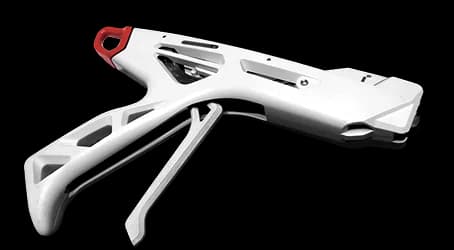
A challenge, a real project
ZipFix sternal implant application instrument
Rethinking a surgical instrument in polymer.
The ZipFix implant applicator replaces a reusable steel architecture with an ergonomic single-use polymer solution. DOMTEKNIKA designed the product, built functional prototypes and coordinated an initial moulded production run. Material, use and manufacturing were considered together.
View projectWhen to involve us
Develop the part and its injection moulding process together.
- Adapt a part for injection moulding
- Replace a metal architecture with a polymer
- Prepare tooling and initial parts
Our approach
Wall thickness, assemblies, material properties and operating conditions are studied together. Depending on the project, mechanical calculations and rheological analyses help refine geometry before tooling.
Choose the architecture
Relate material properties to the intended use.
Prepare moulding
Study geometry, filling and critical areas.
Refine production
Support tooling, trials and initial parts as required.
What you receive
- Material choices and component definition
- Geometry recommendations and analysis as needed
- Tooling documentation and trial support within the agreed scope
Our work ranges from component design to tooling coordination and initial moulded production runs. Trials check real behaviour and inform process adjustments.
We agree the scope, tests and deliverables with you before work begins.
Frequently asked questions.
Explore the full FAQ7 questions
When should we involve you?
Ideally before fixing the geometry or commissioning tooling. We can also analyse difficulties with an existing component.
Can you support initial production runs?
We have coordinated tooling, injection trials and initial production runs. DOMTEKNIKA’s role and the partners’ roles are agreed for each project.
Why consider injection moulding during design?
Geometry affects filling, cooling and ejection. Considering wall thickness, draft and tooling access during design helps limit changes later in development.
Can a prototype component be injection moulded unchanged?
Not always. A geometry developed for a prototype may need changes to its walls, ejection or assembly. The production material and process must be considered before specifying tooling.
How do you select a polymer?
The choice depends on use, loads, temperatures, environment and the processing method. Material properties are assessed together with component geometry and product requirements.
What is checked on the first moulded components?
Dimensions, appearance, assembly and function are assessed against the intended requirements. Observations identify any changes to geometry, tooling or process needed before production continues.
Is injection moulding suitable for small production runs?
It can be, but tooling cost, quantities, geometry and material must be compared. The choice depends on total cost and product requirements, before investing in a mould.
For our first conversation
.Is your component ready for injection moulding?
Share your drawings, proposed material and production volumes. We can review part geometry, the process and tooling constraints.
Discuss your requirements