




Product engineering · Switzerland
Creativity & Innovation.
You have a problem to solve or an idea to develop. We explore possible solutions before you commit to a product architecture.
Discuss your requirementsTechnical insight
From sketches to concepts worth testing.
At DOMTEKNIKA, concept exploration produces sketches and a comparison matrix. The criteria are agreed with you. Selected concepts can then undergo initial calculations or a focused proof of concept before more detailed development.
| Our work | What you receive | What it enables |
|---|---|---|
| Explore | Several operating principles illustrated with sketches. | Compare different solutions to the same need. |
| Evaluate | Scores against agreed criteria such as use, cost, space or manufacturing. | Choose concepts to develop and make trade-offs explicit. |
| Resolve uncertainty | Where needed, a feasibility calculation or a proof of concept for a critical function. | Check a decisive point before detailing the whole product. |
A challenge, a real project
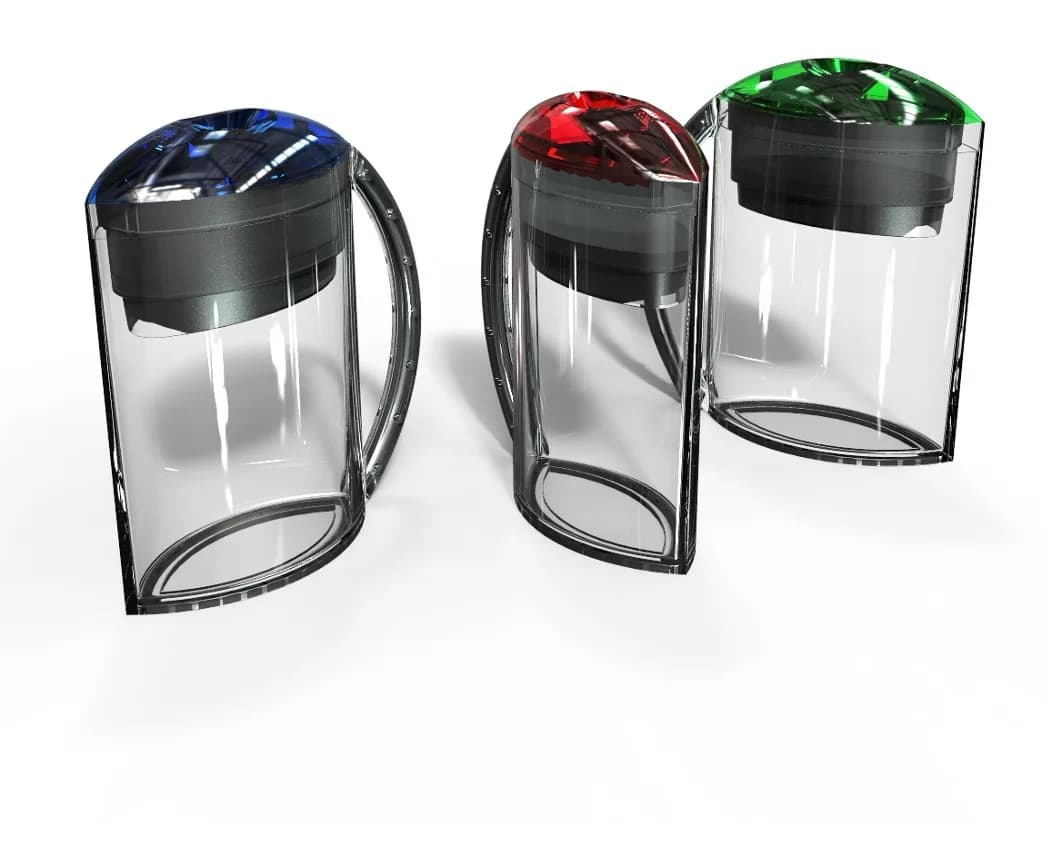
Filter Carafe
A mechanism that measures the water actually filtered.
The filter carafe needed to indicate when its cartridge should be replaced. DOMTEKNIKA developed the complete product and an economical mechanism for counting water volume. The project connects concept exploration, everyday use and integration into a physical product.
View projectWhen to involve us
Turn an open problem into technical options you can compare.
- Explore an idea without a defined technical solution
- Rethink an existing product or mechanism
- Choose an architecture before development
Our approach
We agree the comparison criteria with you: function, cost, available space, manufacturing and use. We then explore several mechanical principles and sketch them so that the options can be discussed and compared.
Frame the problem
Define the need, constraints and comparison criteria.
Explore options
Connect mechanical principles, materials and manufacturing.
Choose the next step
Score ideas against the agreed criteria and identify what needs checking.
What you receive
- Technical concepts illustrated with hand sketches
- A scoring matrix based on the agreed criteria
- Recommendations and the next checks to carry out
Depending on the uncertainties, we can add initial calculations, a SWOT analysis or a focused proof of concept. These additions and the next steps are agreed with you.
We agree the scope, tests and deliverables with you before work begins.
Frequently asked questions.
Explore the full FAQ6 questions
Do we need a specification first?
No. A description of the problem, intended use and known constraints is enough to start structuring your requirements.
Can this stage include a proof of concept?
Yes, when an uncertainty warrants it. A proof of concept (POC) can be a simple test assembly or partial prototype that checks a principle with limited expenditure. The function to test and the success criteria are defined before it is built.
How do you compare different concepts?
We agree the criteria and their importance with you: function, use, cost, space or manufacturing. The sketched ideas are assessed in a scoring matrix. Trade-offs and uncertainties remain visible when choosing which concepts to develop.
Can you improve an existing product?
Yes. A problem with use, assembly or manufacturing can be the starting point. We examine the functions to preserve and the constraints to improve before proposing changes to the concept.
Is an attractive idea already a feasible solution?
An idea still needs to be assessed against materials, loads, available space and manufacturing. Initial studies identify uncertainties and help decide what needs checking first.
How does a POC differ from a complete prototype?
A proof of concept (POC) checks the feasibility of a specific principle or function through a deliberately limited build. A more complete prototype can examine several functions and their integration. A successful POC therefore does not validate the whole product or its readiness for production.
For our first conversation
.Which idea would you like to develop?
Tell us how the product will be used and which problem it needs to solve. We can explore the most relevant concepts and define the first checks.
Discuss your requirements