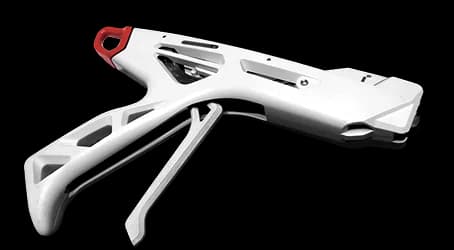


US2015342657 (A1)
BONE FIXATION ASSEMBLY.
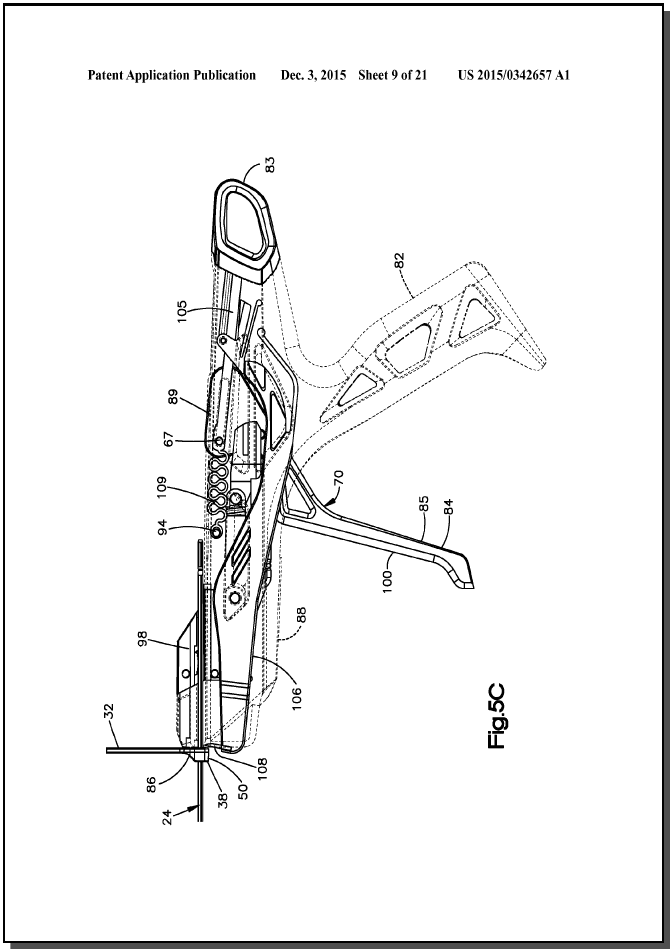
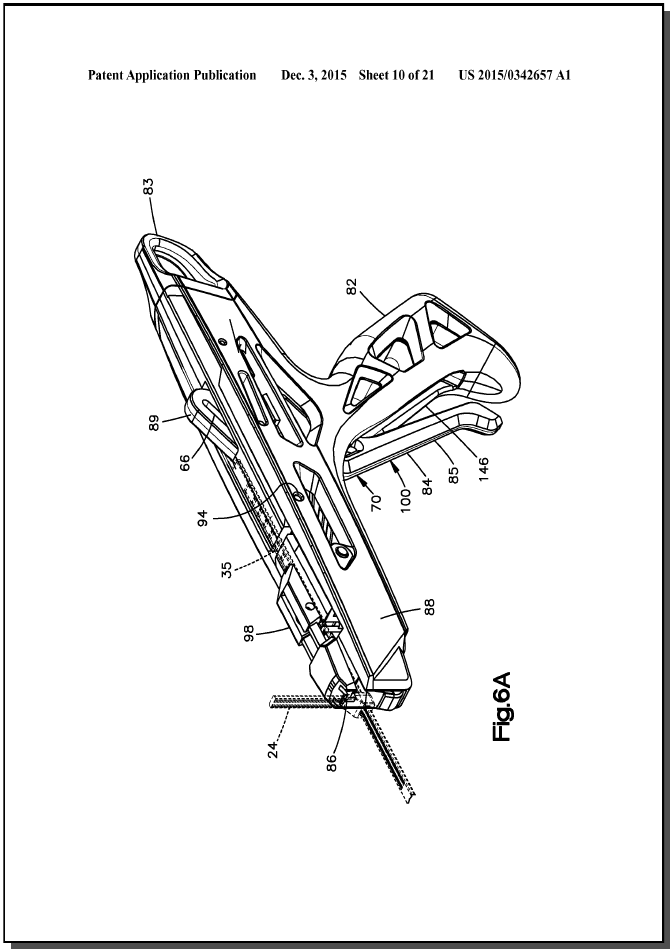
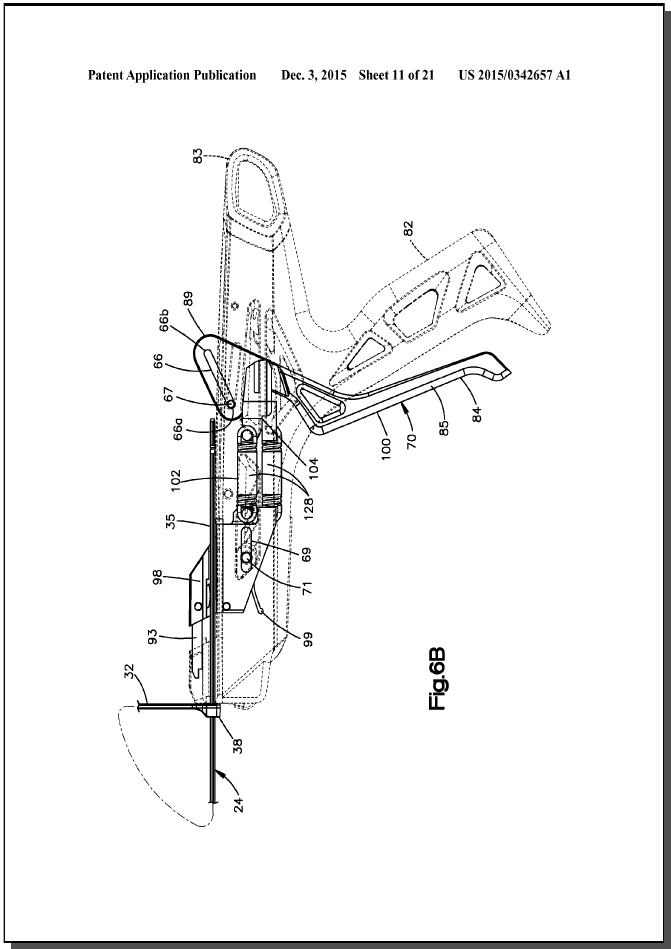
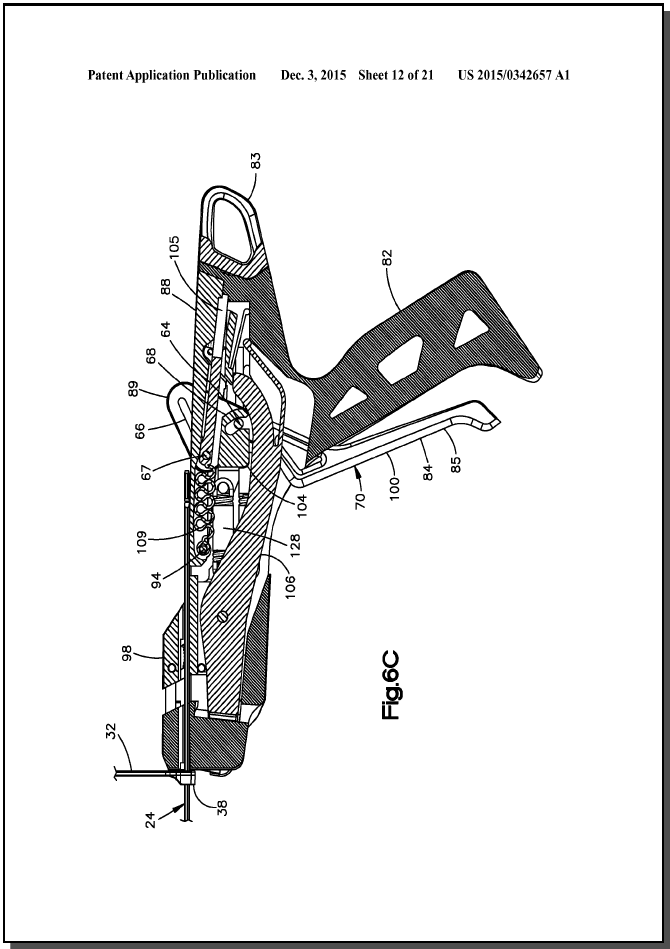
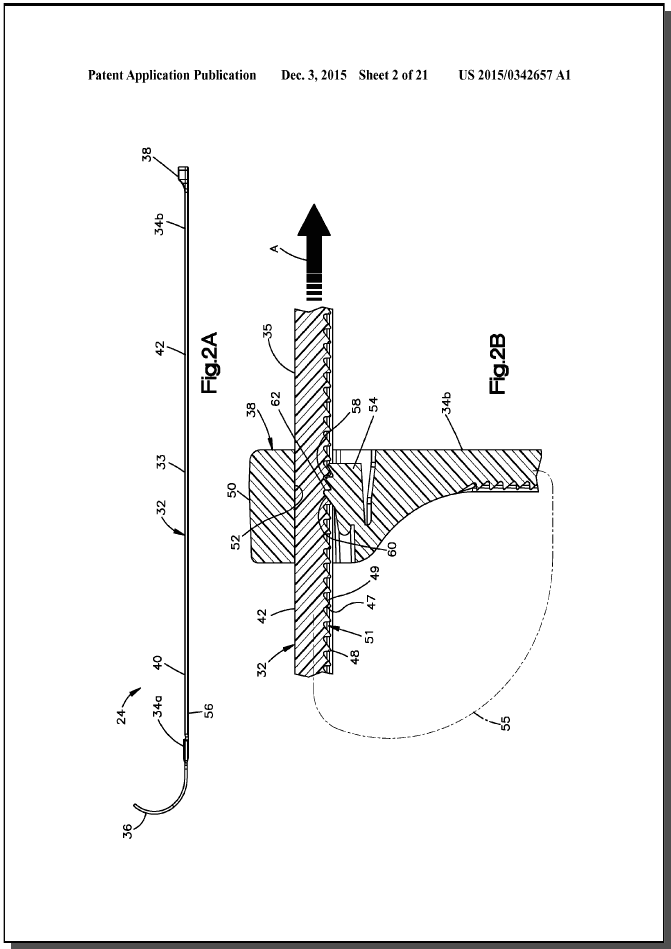
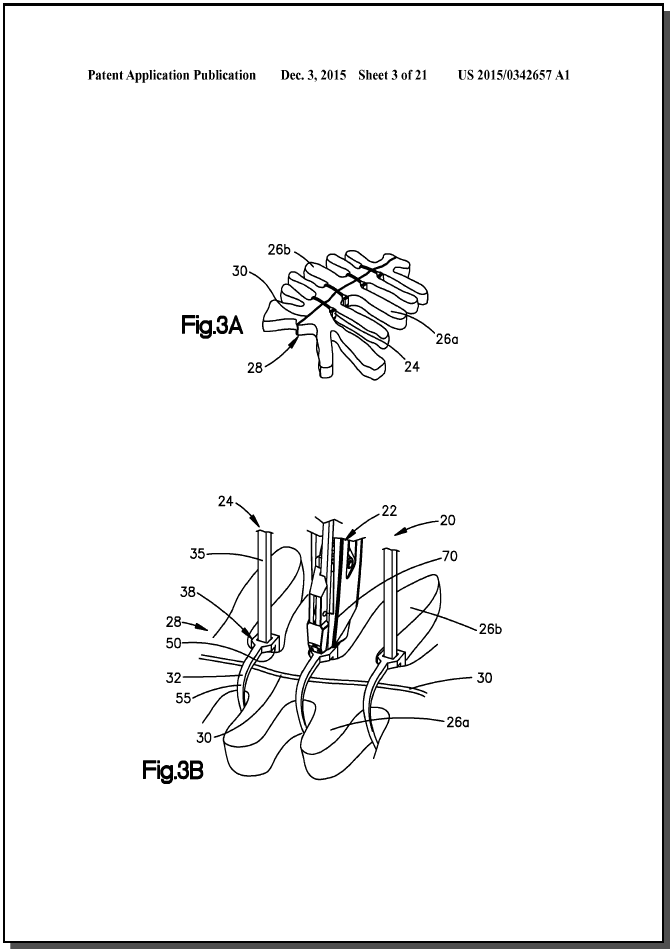
A bone fixation system includes at least one bone fixation member and a bone fixation instrument. The bone fixation member includes a strap and a locking mechanism. The strap can be pulled through the locking mechanism so as to form a loop about a target bone so as to secure first and second bone segments in an approximated, compressed configuration. The bone fixation instrument is configured to apply tension to the loop about the target bone. The fixation instrument includes a tension assembly that is configured to secure a free end of the bone fixation member to the fixation instrument. The tension assembly is further configured to pull the free end so as to increase tension in the loop while the tension in the loop is less than a select tension. The tension assembly is unable to further increase tension in the bone fixation member once the tension in the bone fixation member has reached the select tension. The fixation instrument further includes a cutter assembly that is configured to cut the free end of the bone fixation member so as to separate the free end from the loop.
- Publication
- US2015342657 (A1)
- Publication date
- 2015-12-03
- Priority date
- 2014-05-30
- Inventors
- THULIEZ JEAN-LUC [CH]; VOISARD CYRIL [CH]; OBLIGER NICOLAS [FR]; MOOTIEN AZAGEN [FR]; CROZIER ETIENNE [CH]
- Applicants
- DEPUY SYNTHES PRODUCTS INC [US]
- Classification
- Classification: - internationale A61B17/58; A61B17/60; A61B17/82; A61B17/84; A61B17/88; A61F2/00 - coopérative A61B17/823 (EP, CN, US); A61B17/842 (EP, CN, US); A61B17/8861 (EP, CN, US); A61B17/8863 (EP, CN, US); A61B17/8869 (EP, CN, US); A61B17/8872 (EP, CN, US)
Patent family publications
Related projects
Project images
Description
CROSS-REFERENCE TO RELATED APPLICATIONS
[0001] This claims the benefit of U.S. Patent Application Ser. No. 62/005,552 filed May 30, 2014, the disclosure of which is hereby incorporated by reference as if set forth in its entirety herein. BACKGROUND
[0002] In order to provide access to certain internal anatomy, such as the heart during an open heart procedure, midline sternotomies are typically performed. A midline sternotomy creates a cut substantially along the midline of the sternum, thereby dividing the ribcage into two halves and allowing the surgeon to move the ribcage so as to provide access to the heart. Upon completion of the open heart procedure, it is desired to approximate and compress the sternum, and rigidly maintain the sternal halves in their approximated position relative to each other so that the sterna halves are restricted from moving with respect to each other to promote bone fusion in the weeks following the surgical procedure.
[0003] During normal anatomical function, for instance during respiration, body movement, and carrying of objects, forces can be generated that act on the sternum. One conventional system sternal fixation assembly includes stainless steel wires that are placed either parasternally (around the sternum) or transsternally (through the sternum bone) using a cutting needle that is attached to the wire, and subsequently twisted to tighten the wire against the sternum. However, the twisting generates tensile forces onto the wires that tend to weaken the wire, which can result in breakage both during the closure or post-operatively. Furthermore, this type of system relies on the experience of the surgeon when tightening the wires. If the wires are not tightened enough, the sternal compression can be compromised. If the wires are tightened too much, the wire can cut into or through the sternum and/or can break. SUMMARY
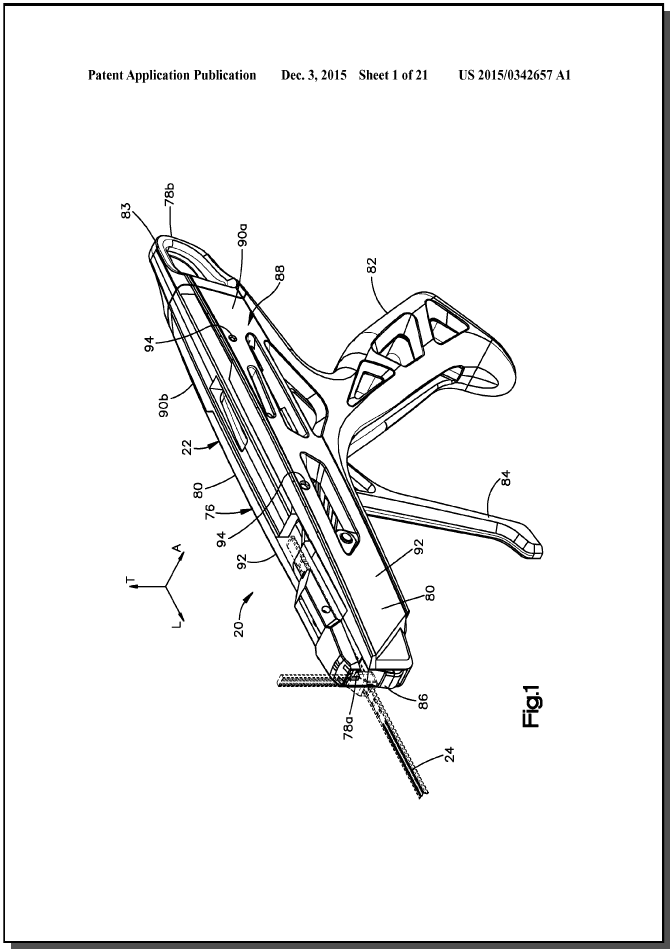
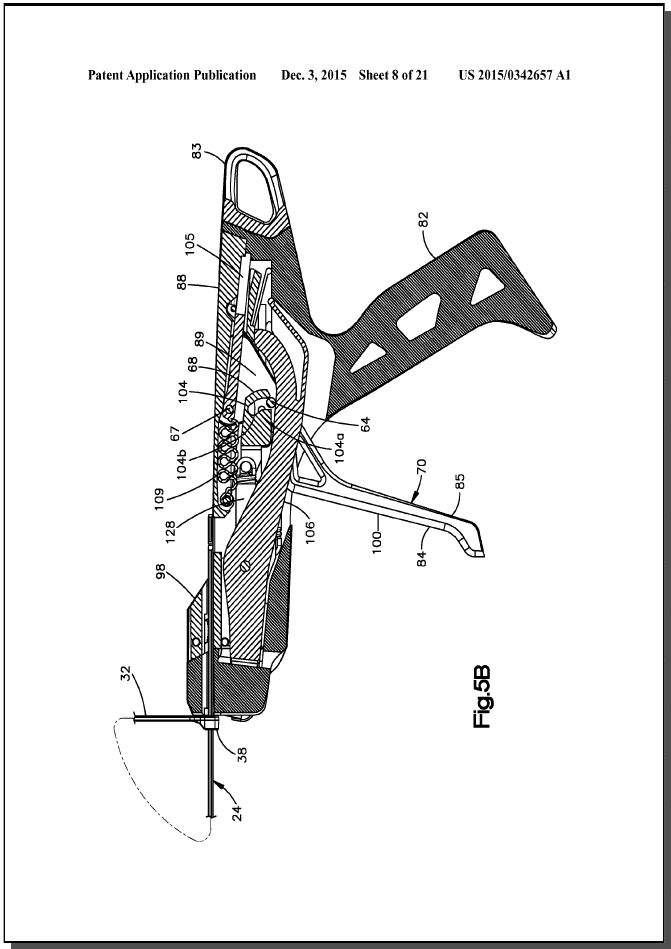
[0004] In accordance with one embodiment, a bone fixation instrument has a front end and a rear end spaced from the front end in a rearward direction. The bone fixation instrument can be configured to apply tension to a bone fixation member so as to tighten the bone fixation member about a target bone. The bone fixation instrument can include a grip configured to attach to a free end of the bone fixation member. The bone fixation instrument can further include a traveler that supports the grip such that as the traveler moves in the rearward direction, the grip moves along with the traveler in the rearward direction so as to increase tension in the bone fixation member when the grip is attached to the bone fixation member. The bone fixation instrument can further include a cutter arm that carries a cutter blade and is configured to move the cutter blade to a cutting position whereby the cutter blade severs the free end of the bone fixation member when the grip is attached to the bone fixation member. The bone fixation instrument can further include an actuator configured to be selectively independently coupled to the traveler and the cutter arm. The bone fixation instrument can further include a toggle member that is movable between a first and a second position. When the toggle member is in the first position, the bone fixation instrument can be in a tensioning mode whereby movement of the actuator causes the traveler to move in the rearward direction thereby increasing the tension in the bone fixation member when the grip is attached to the bone fixation member. When the toggle member is in the second position, the bone fixation instrument can be in a cutting mode whereby movement of the actuator causes the cutter arm to move the cutter blade to the cutting position. BRIEF DESCRIPTION OF THE DRAWINGS
Claims
- 1. What is claimed:
- 1. A bone fixation instrument having a front end and a rear end spaced from the front end in a rearward direction, the bone fixation instrument configured to apply tension to a bone fixation member so as to tighten the bone fixation member about a target bone, the bone fixation instrument comprising: a grip configured to attach to a free end of the bone fixation member;a traveler that supports the grip such that as the traveler moves in the rearward direction, the grip moves along with the traveler in the rearward direction so as to increase tension in the bone fixation member when the grip is attached to the bone fixation member;a cutter arm that carries a cutter blade and is configured to move the cutter blade to a cutting position whereby the cutter blade severs the free end of the bone fixation member when the grip is attached to the bone fixation member;an actuator configured to be selectively independently coupled to the traveler and the cutter arm; anda toggle member movable between a first and a second position, wherein 1) when the toggle member is in the first position, the bone fixation instrument is in a tensioning mode whereby movement of the actuator causes the traveler to move in the rearward direction thereby increasing the tension in the bone fixation member when the grip is attached to the bone fixation member, and 2) when the toggle member is in the second position, the bone fixation instrument is in a cutting mode whereby movement of the actuator causes the cutter arm to move the cutter blade to the cutting position.
- 2. The bone fixation instrument as recited in claim 1, wherein when the bone fixation instrument is in the tensioning mode and the grip is attached to the bone fixation member, movement of the actuator causes the traveler to move in the rearward direction until the tension in the bone fixation member reaches a predetermined tension.
- 3. The bone fixation instrument as recited in claim 2, further comprising a force transfer member and a tension limiter coupled between the tension limiter and the traveler, wherein the force transfer member is coupled to the actuator when the bone fixation member is in the tensioning mode, and decoupled from the actuator when the bone fixation member is in the cutting mode.
- 4. The bone fixation instrument as recited in claim 3, wherein the deformation of the tension limiter causes the traveler to move rearward in response to movement of the actuator toward the second position when the tension in the bone fixation member is less than a predetermined tension, and does not cause the traveler to move in the rearward direction in response to movement of the actuator toward the second position when the tension in the bone fixation member reaches the predetermined tension.