


US2020154939 (A1)
车用饮料制备装置.
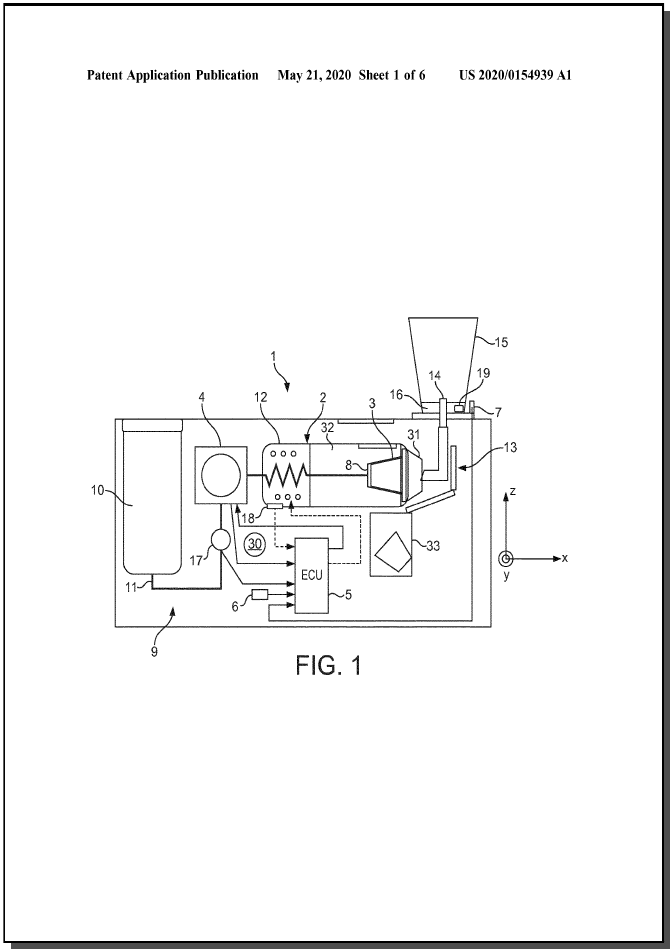
[0001] 本发明涉及一种用于制备饮料的装置(1),更具体地,用于车辆,包括:用于接收一定剂量(3)的饮料配料的冲泡单元(2),用于将加压液体供应到冲泡单元的压力泵(4),用于选择性地控制压力泵的启动的电子控制单元(5),其中电子控制单元(5)布置成通过向压力泵提供输出作为响应来控制压力泵(4)的启动和停用。输入指示相对于水平线和/或相对于检测到的空间位移或加速度的所确定的倾斜角;所述输入是从倾斜角和/或位移感测装置(6)接收的,所述倾斜角和/或位移感测装置(6)是设备的一部分和/或外部的。
- 公开号
- US2020154939 (A1)
- 公开日期
- 2020-05-21
- 优先权日
- 2017-04-11
- 发明人
- THULIEZ JEAN-LUC [CH]; ROMAND DAMIEN [CH]; CROZIER ETIENNE [CH]; HOFFET ADRIEN [CH]; MAGATTI MARCO [CH]
- 申请人
- NESTLE SA [CH]
- 分类
- Classification: - internationale A47J31/00; A47J31/36; A47J31/52 - coopérative A47J31/005 (EP, US); A47J31/3676 (US); A47J31/52 (EP); A47J31/521 (EP, US); A47J31/525 (EP, US); A47J31/5253 (EP); A47J31/5255 (EP);
专利族公开文本
项目图片
说明
FIELD OF THE INVENTION
[0001] The invention relates to the field of beverage preparation in a beverage preparation device using capsules containing ingredients. More particularly, the invention relates to a device for use in vehicles. The invention also relates to a vehicle comprising the beverage preparation device and a method for preparing a beverage from the beverage preparation device. BACKGROUND OF THE INVENTION
[0002] The beverage preparation devices using capsules containing beverage ingredients such as ground coffee are very popular for their convenience, the consistent quality and quick preparation.
[0003] Certain beverage devices have been developed more specifically for being installed in a low voltage vehicle such as the one described in EP1277428B1. The device is an espresso coffee machine designed for a vehicle using a low power source, comprising a reservoir for the water which is connected to a pump to convey the water to a heating element, which itself is connected to an extraction head for a portion of coffee, a mobile fastener for the said head with a means which makes it possible to displace the said fastener from a position of opening to a position of closure and vice versa.
[0004] WO2014086915A1 relates to a beverage preparation device comprising a brewing unit for receiving the capsule and preparing the beverage from the ingredients by injecting liquid into the capsule, a receptacle support means, beverage delivery means and injection means adapted to selectively open a portion of the outlet wall of the receptacle (e.g., bottom of the receptacle) and to establish fluid communication between the beverage delivery means and the receptacle. The advantage is that beverage can be filled from the bottom of the receptacle thereby avoiding beverage spilling on the surface of the device or vehicle.
[0005] However, there is a need for a beverage device that can be used in vehicles while providing enough safety, when the usage of the beverage device is not conformed to the road traffic regulations and/or when the usage is prone to create distraction of the driver that could lead to accidents. For example, it may be inappropriate or dangerous to allow the usage of the beverage device while the vehicle moves or is parked on a steep slope. The present invention provides a simple solution to these problems. SUMMARY OF THE INVENTION
[0006] The invention relates to a device for preparing a beverage, more particularly, for a vehicle comprising: a brewing unit for receiving a dose of beverage ingredients, a pressure pump for supplying pressurized liquid to the brewing unit, an electronic control unit for selectively controlling the activation of the pressure pump,
[0010] wherein the electronic control unit is arranged to control the activation and de-activation of the pressure pump, by providing output to the pressure pump as response to input indicative of a determined inclination angle relative to horizontal and/or to a detected spatial displacement or acceleration; said input being received from inclination angle and/or displacement sensing means which are part and/or foreign to the device.
[0011] By “spatial displacement” or “acceleration”, it is meant a displacement or an acceleration that is measured independently from pure gravity.
[0012] Therefore, the pressure pump of the beverage device can be controlled by the electronic control unit of the device as response to a spatial displacement or acceleration and/or an inclination relative to horizontal of the device itself or of the vehicle in which the device is embarked or eventually of a portable computer in short-range communication with the device and also embarked in the vehicle. Therefore, it is possible for the device to control the activation of the pump such as to stop or resume the liquid flow depending on such information. Therefore, it is possible to adapt the usage of the device to certain conditions such as conditions related to safety, road traffic or particular regulations for instance.
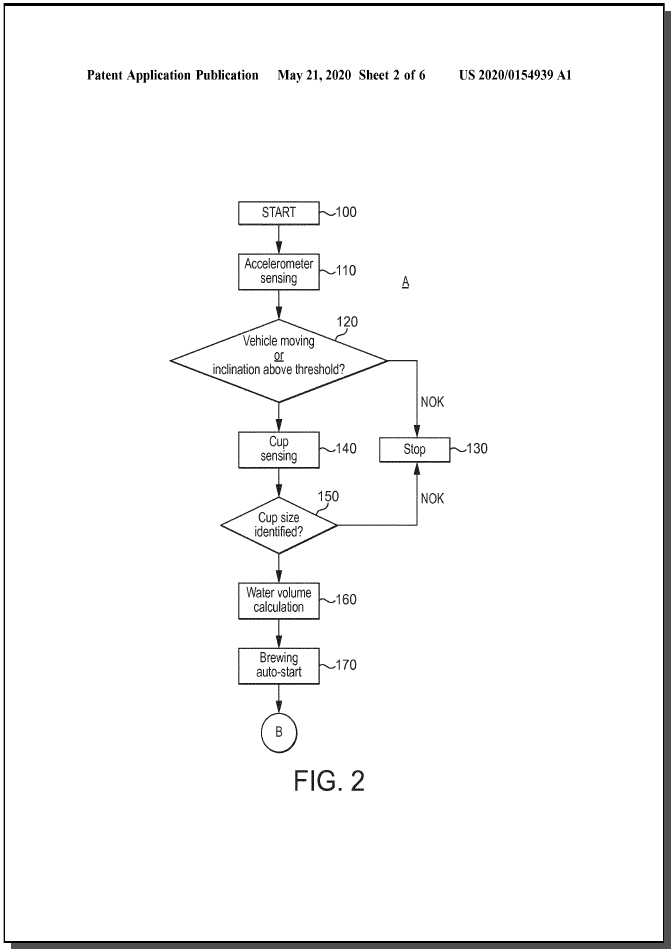
[0013] Preferably, the electronic control unit is arranged for stopping the pressure pump upon receiving an input from the sensing means indicative of a spatial displacement or acceleration of the device and/or an input indicative of an inclination angle, at or above a predetermined set point. Therefore, it is possible for the device to stop the preparation of the beverage device when the vehicle starts moving and/or is too inclined.
[0014] For example, such input can be indicative of an inclination angle and a predetermined set point can be a value of inclination angle of 25 degrees, preferably 30 degrees. Such set point of inclination angle may also be set in function of other parameters which may be sensed and received by the electronic control unit such as the size of the receptacle and/or the volume of liquid supplied to the brewing unit by the pressure pump.
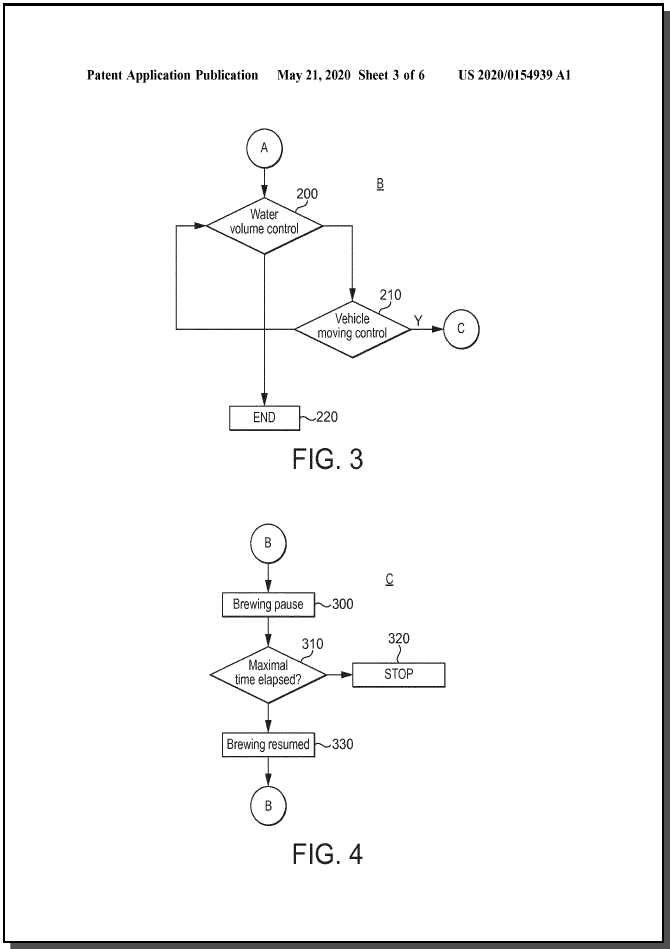
[0015] Preferably, the electronic control unit is arranged for resuming the activation of the pressure pump at least once when receiving a second input indicative of a spatial displacement or acceleration delayed from the first input indicative of a spatial displacement or acceleration at or below a predetermined time set point. Such second input may indicate that the device is no longer displaced or accelerated. Such indication may be indirect in that it can be associated to a spatial displacement or acceleration of the vehicle and/or a portable computer such as a smart phone for example. The electronic control unit may further be arranged for maintaining the pressure pump inactivated (i. e. not resuming the activation of the pressure pump), when receiving said second input indicative of a spatial displacement or acceleration delayed from said first input, if a time condition is not met, for example, if a time set point has already been reached or exceeded, such as for example, if a too long time has elapsed between the first and second inputs. This may be particularly advantageous to prevent the preparation of a beverage which has had time to cool down during the pause. For example, the time set point for maintaining the pressure pump inactivated can be 120 or 180 seconds.
[0016] In other words, the beverage preparation can be continued after a pause of the pump when the duration for such pause is not too long or after several pauses when the total duration of the pauses has not exceeded a given time limit. The time of the pause can be controlled by the electronic control unit for resuming the liquid flow to the brewing unit while the beverage already dispensed in the receptacle has not had time to cool down and/or the head of foam has not vanished. The number of pauses can also be determined by the control unit.
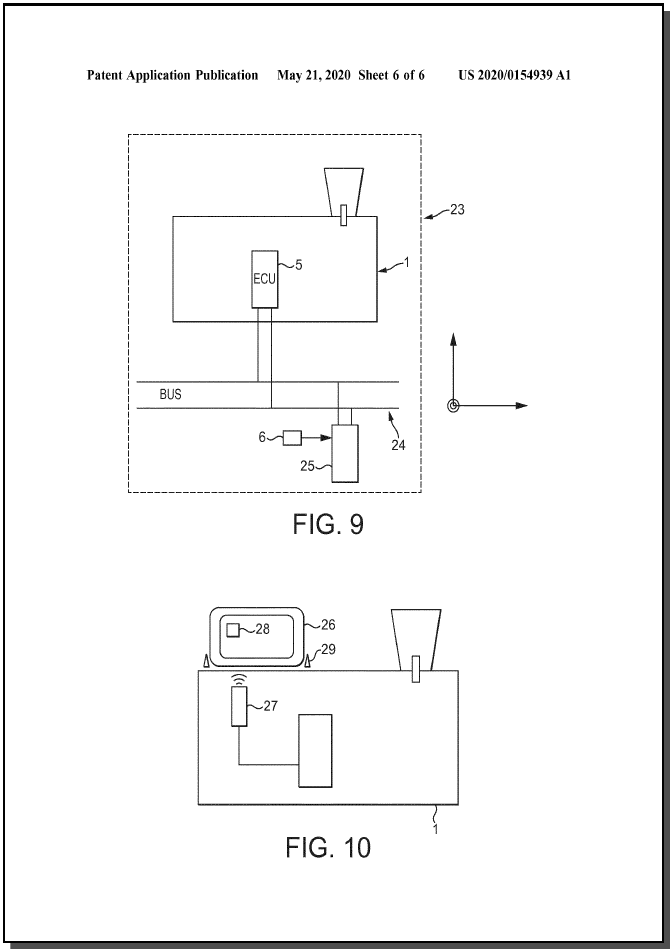
[0017] The device may comprise inclination angle and/or displacement sensing means selected amongst the list of: an accelerometer, a gyro-meter, gyroscope, an inclinometer, a GPS, an optical inclination measuring device and combinations thereof. The use of an accelerometer is preferred for cost and performance reasons. The accelerometer can be, for instance, a piezoelectric, piezo-resistive or a capacitive component which is commonly used to convert the mechanical motion into an electrical signal. It may be a small micro electro-mechanical system (MEMS).
[0018] In a possible mode, the electronic control unit of the beverage preparation device is connected to the controller area network (CAN) of the vehicle in a manner to receive input from the inclination angle and/or displacement sensing means belonging to a different node of the controller area network. In other words, the input received by the electronic control unit is obtained directly from the CAN bus of the vehicle.