


US2025129628 (A1)
低碳足迹汽车工厂.
一种用于制造电动或混合动力车辆的工厂(01),该工厂(01)在一个地点包括至少一个用于车辆的组装空间(10),在该组装空间中不进行钢材转化操作,从而很大程度上消除了有毒排放、化学废物的产生、噪音污染、振动、灰尘和水的消耗,从而该工厂可以安装在住宅区附近或住宅区中。
- 公开号
- US2025129628 (A1)
- 公开日期
- 2025-04-24
- 优先权日
- 2021-12-24
- 发明人
- HEISEL GUILLAUME [CH]; THULIEZ JEAN-LUC [CH]; QUERRY HECTOR [CH]; TOURAT YANNICK [FR]; CROZIER ETIENNE [CH]; LANDWERLIN STÉPHANE [CH]
- 申请人
- SOFTCAR SA [CH]
- 分类
- Classification: - internationale B60S5/00; B62D29/04; B62D65/02; E04H5/02 - coopérative B60S5/00 (US); B62D29/04 (US); B62D63/025 (EP); B62D65/02 (US); B62D65/022 (EP); E04H5/02 (EP, US)
专利族公开文本
相关项目
项目图片
说明
CORRESPONDING APPLICATION
[0001] The present application claims the priority of the earlier application No. PCT/IB2021/062291 filed 24 Dec. 2021 in the name of Softcar SA, the content of said earlier application being incorporated by reference in its entirety in the present application. TECHNICAL FIELD
[0002] The present invention concerns the layout of an automobile plant with a small carbon footprint intended for the production of battery-powered vehicles in which subassemblies or modules are received that have already been partially assembled. This plant notably has the particular feature of not including a metal processing line that generates noise, pollution and vibration. This plant can therefore be located near residential areas and welcome individuals seeking to purchase, rent, refurbish, repair, modify or recycle a vehicle. Said plant also includes a plurality of buildings, those with the highest risk of incidents being separated from the rest of the infrastructure for safety and cost reasons. PRIOR ART
[0003] Automobile assembly plants are generally huge because they contain a metal processing line several kilometers long. Said line enables paying out of sheet metal, degreasing, oiling, preliminary cutting out of parts (for example body parts) by stamping them, degreasing again, welding together, phosphate treatment, painting by cataphoresis and finally curing the paint.
[0004] Apart from the fact that the production of the steel itself and the rolling operation generate enormous quantities of CO2 all the transformation operations described hereinabove are highly polluting: 35% wastage of sheet steel during stamping, use of oils for pressing, use of heavy solvents for degreasing, use of phosphorus-containing agents for the phosphate treatment necessary in preparation for cataphoresis, consumption of water for the rinsing steps, use of enormous quantities of energy in drying/curing ovens, and emission of gases in a number of these operations. In addition to chemical waste and toxic emissions, these plants also generate considerable noise and vibration. This renders working conditions difficult.
[0005] Their size makes them very costly to build, operate and maintain. Because of their size and the nuisances they cause (noise, waste, emissions, vibration) these plants must be far away from residential areas, obliging manufacturers to transport the vehicles produced from the production center to the points of sale by additional means such as trucks or trains (whereas the vehicles manufactured could travel by their own means), thus causing additional grey energy pollution.
[0006] The metal treatment line generally rules out any modularity because the first element is the monocoque sheet metal chassis, the structure onto which all the other components are assembled. This way of mass producing cars is based on optimization of the steel, which process has been the same since 1932, and is universally spread across the entire planet.
[0007] Battery-powered vehicles necessitate the fitting of propulsion batteries, generally lithium-ion batteries. This is carried out on the assembly line, making the presence of said batteries at the heart of the plant obligatory. As these plants are generally designed for the manufacture of internal combustion engine vehicles, the batteries are fitted on the existing production lines on changing over from the production of internal combustion engine vehicles to the production of electric or hybrid vehicles. In the event of fire the inflammable electrolytes of a battery generate their own oxidizer, which cannot be extinguished. The fire runs away and rapidly becomes impossible to contain. Consequently, a fire in only one battery on the assembly line can cause considerable damage because the intensity of the flames and the column of heat at more than 800° C. rising to a height of 8 m can affect the structure of the building. The fire will last until all of the electrolyte has been consumed.
[0008] If a lithium-ion battery element of an electric car catches fire, spraying it with water merely cools everything, and does not extinguish the fire. This water used for cooling becomes highly contaminated. Its chemical load even exceeds the limiting contamination values for industrial wastewater. It is therefore imperative for this water to undergo treatment before it flows into the drainage system.
[0009] The smoke from the fire would make it obligatory for the plant to be entirely evacuated and to halt all production prior to decontamination. The soot emitted during a battery fire contains large quantities of cobalt oxide, nickel oxide and manganese oxide and it is therefore the entire site that would have to be decontaminated before restarting production. SUMMARY OF THE INVENTION
[0010] One object of the invention is therefore to improve the methods and processes for manufacturing vehicles and the means necessary for this purpose, such as in particular the plant.
[0011] Another object of the invention is to minimize or even to eliminate the emission of carbon during the manufacture of vehicles.
[0012] Another object of the invention is to simplify vehicle manufacturing methods and to locate the manufacturing plant closer to consumers to reduce the necessity for transportation, in particular transportation by road, of the vehicles manufactured there.
[0013] Preferably, in accordance with non-limiting principles of the invention: 1) The vehicle must preferably include at least one propulsion battery (electric, hybrid or other vehicle), it must be possible to fit batteries to the vehicles, and the batteries must be assembled in a separate building that will be sacrificed in the event of fire. 2) The vehicle must contain little grey energy. To reduce grey energy and to recover materials at end of life the plant should preferably be constructed near or in a town. To be constructed in or near a town the plant must achieve “zero” emissions and “zero” water pollution and the assembly center must imperatively be of small size. To be of small size the metal treatment line must be eliminated from the manufacturing process and replaced by another process, for example an SKD process and rotational molding as described in the present application. The method and the plant must preferably integrate services, showroom, recycling of complete bodies, retrofitting, repairs, and change of body retaining the propulsion chassis. The center must preferably be close to a railway to supply components by train and the plant must be equipped with a component delivery dock.
[0016] In accordance with the invention there have been developed a new plant architecture and a new vehicle manufacturing method based on that plant architecture enabling this simplification and reduction of emissions.
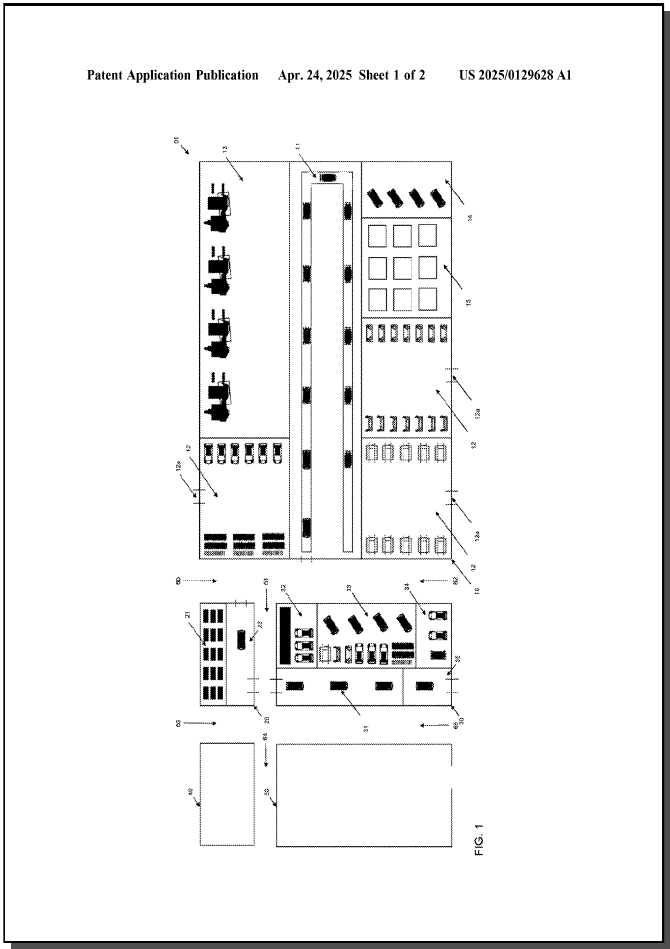
[0017] The principles of the present invention, of the new plant architecture and of the method used are described hereinafter with reference to embodiments and illustrative drawings.
权利要求
- 1. A plant for manufacturing electric or hybrid vehicles, said plant including on a site at least one assembly space for assembling said vehicles in which no operation of transformation of steel is carried out, thereby eliminating most toxic emissions, the production of chemical or other waste, sound pollution, vibration, odors, dust and the consumption of water so that said plant can be located near or in residential zones.
- 2. The plant as claimed in claim 1 further including on said site at least one of the following elements: a showroom open to the public and intended for vehicle purchasing; a retrofit space intended for the renovation of ageing vehicles to give them a second life; a recycling space intended for recycling components of vehicles at end of life; an ASS space intended for the repair of vehicles in circulation and for changing elements of said vehicles; a battery building dedicated to the storage of and the fitting of propulsion batteries in said vehicles, said battery building being separated from the rest of said plant by one or more fire breaks.
- 3. The plant as claimed in claim 1 in which polymer bodies are ground up in its recycling space.
- 4. The plant as claimed in claim 1 carrying out a change of body on a vehicle in circulation in its ASS space.
- 5. The plant as claimed in claim 1 functioning in a semi knocked down (SKD) system in which subassemblies arrive in said plant pre-assembled and pre-inspected after which said subassemblies are assembled in the assembly space to produce the finished vehicle.
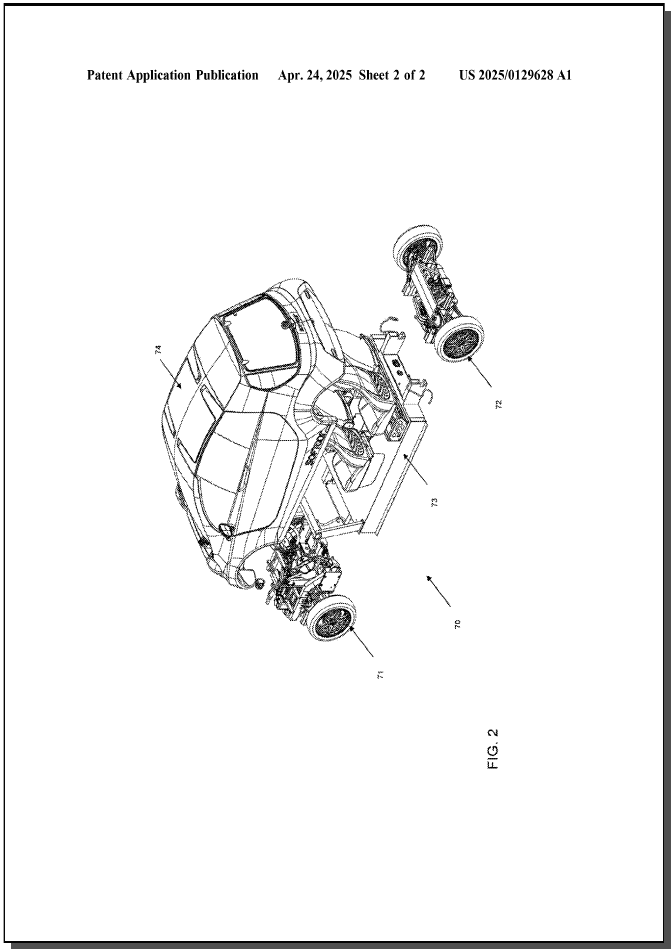
- 6. The plant as claimed in claim 1 intended for the assembly of vehicles comprising four modules: a front subframe module, a rear subframe module, a central platform chassis module and a body module.
- 7. The plant as claimed in claim 6 in which the bodies are made of polymer and produced on site in the assembly building.
- 8. The plant as claimed in claim 6 in which said chassis modules arrive already partially or completely assembled and are assembled in the assembly building to form the chassis.
- 9. The plant as claimed in claim 1 in which said battery building is a rudimentary building of small size, thus having a low cost of construction and adapted to be rapidly reconstructed or renovated at lower cost in the event of an incident.
- 10. The plant as claimed in claim 1 including at least one space dedicated to the erection of a battery tent separated from the rest of said plant by one or more fire breaks, said battery tent being usable to carry out the operations intended to be carried out in the battery building if the latter is not functional.
- 11. The plant as claimed in claim 10 including at least one workshop building separated from the rest of said plant by one or more fire breaks and dedicated to operations of adjustment, inspection, repair, ASS, retrofit, recycling or other operations on vehicles fitted with propulsion batteries.
- 12. The plant as claimed in claim 11 in which said workshop building is a rudimentary building of small size, thus having a low cost of construction and adapted to be rapidly reconstructed or renovated at lower cost in the event of an incident.
- 13. The plant as claimed in claim 11 including at least one space dedicated to the erection of a temporary shelter, such as a workshop tent, separated from the rest of said plant by one or more fire breaks, said shelter being usable to carry out the operations intended to be carried out in the workshop building if the latter is not functional.
- 14. A method of manufacturing vehicles, in particular battery-powered vehicles, based on the layout of a plant as described in the present application or executed by a plant as claimed in claim
- 1.
- 15. A method of manufacturing vehicles, in particular battery-powered vehicles, by the following process: modules or module parts intended to form a vehicle are manufactured in a dedicated and decentralized plant;the modules or parts thereof are taken by non-polluting or low pollution transport means to a centralized assembly plant near customers;elements of the vehicle, such as the body for example, are produced in the assembly plant;modules, parts of modules and elements of the vehicle are assembled in dedicated parts of the assembly plant, some dedicated parts of the plant being intended to be sacrificed in the event of problems and replaced by equivalent and temporary or non-temporary parts in order to prevent halting or reducing production;in the same assembly plant there are provided parts dedicated to sales, repairs, replacement, maintenance, retrofitting, dismantling, recycling and recovery of modules or parts of modules of existing vehicles or complete vehicles.