


US2022141591 (A1)
유도 전동기의 고정 권선 냉각 시스템.
본 발명은 유도 전동기의 고정 권선을 냉각시키는 원리에 관한 것이며, 상기 권선은 가동 전기자 외부에 위치된다. 냉각은 냉각 핀, 팬이 있거나 없는 권선의 환기를 허용하는 개구부, 보울 외부의 유체 회로, 보울 내부의 유체 회로, 권선 내부의 유체 회로 및/또는 보울 내부의 히트 파이프 추가를 통해 달성될 수 있습니다. 제시된 이 모터는 스피커나 진동기 내부에 제한 없이 사용할 수 있습니다.
- 공개번호
- US2022141591 (A1)
- 공개일
- 2022-05-05
- 우선일
- 2019-02-06
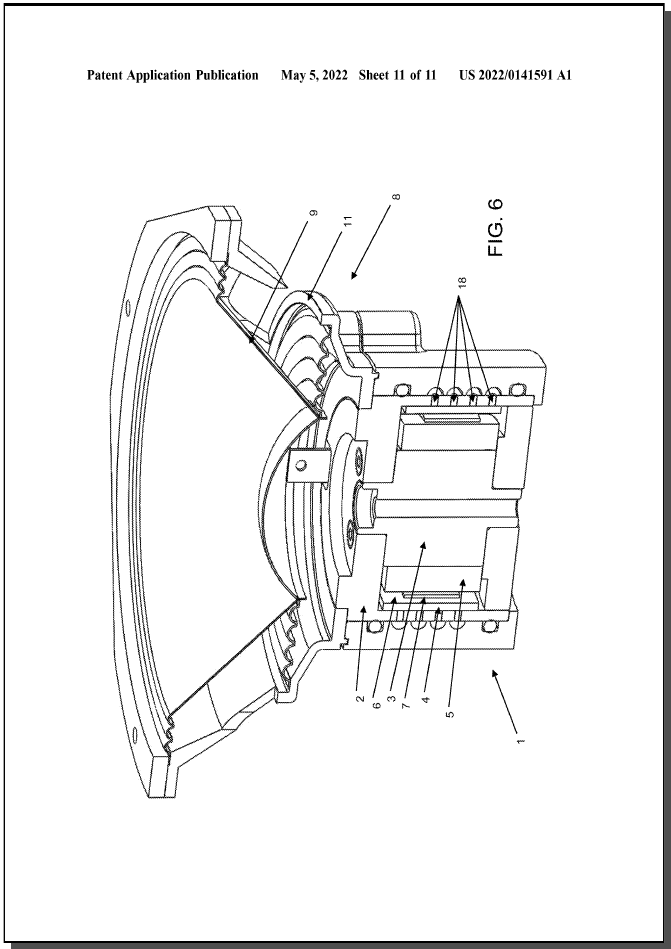
- 발명자
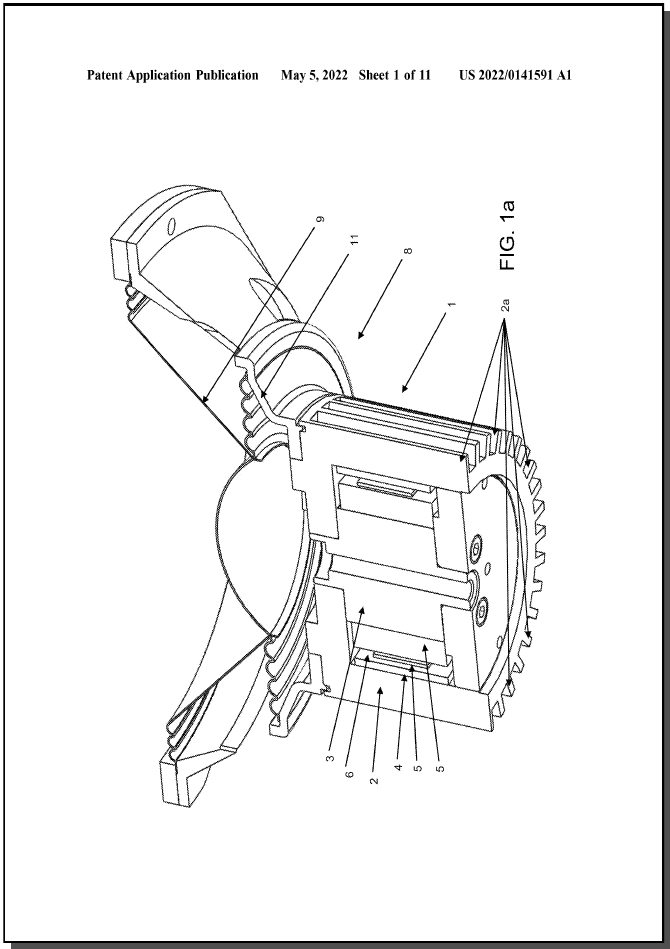
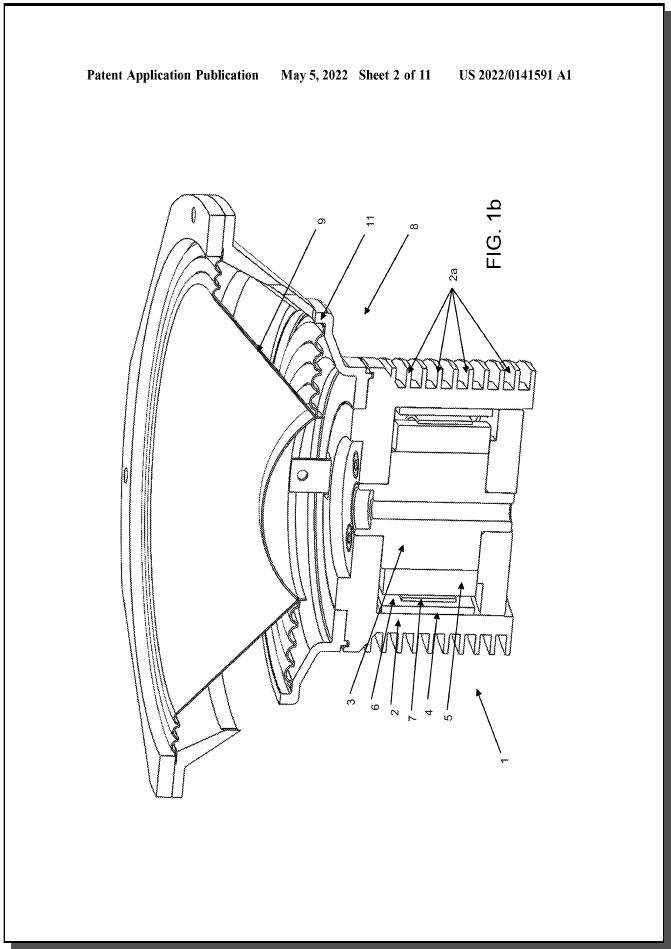
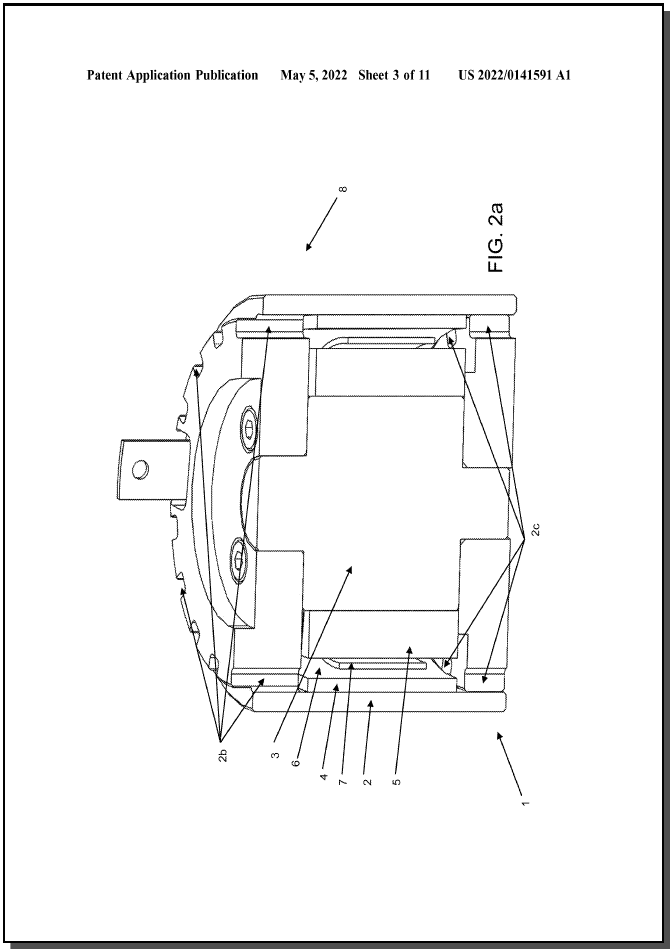
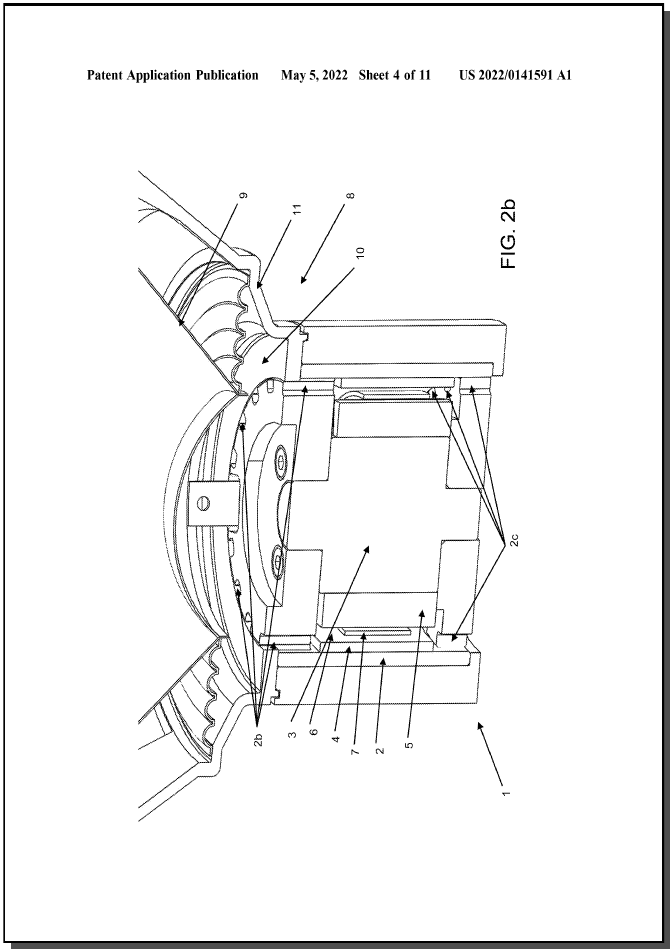
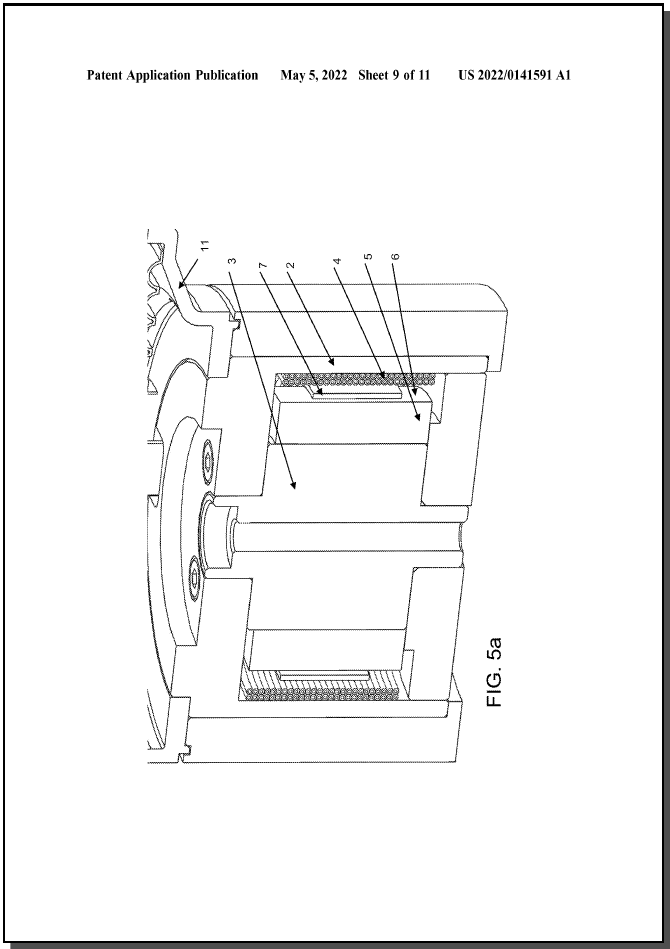
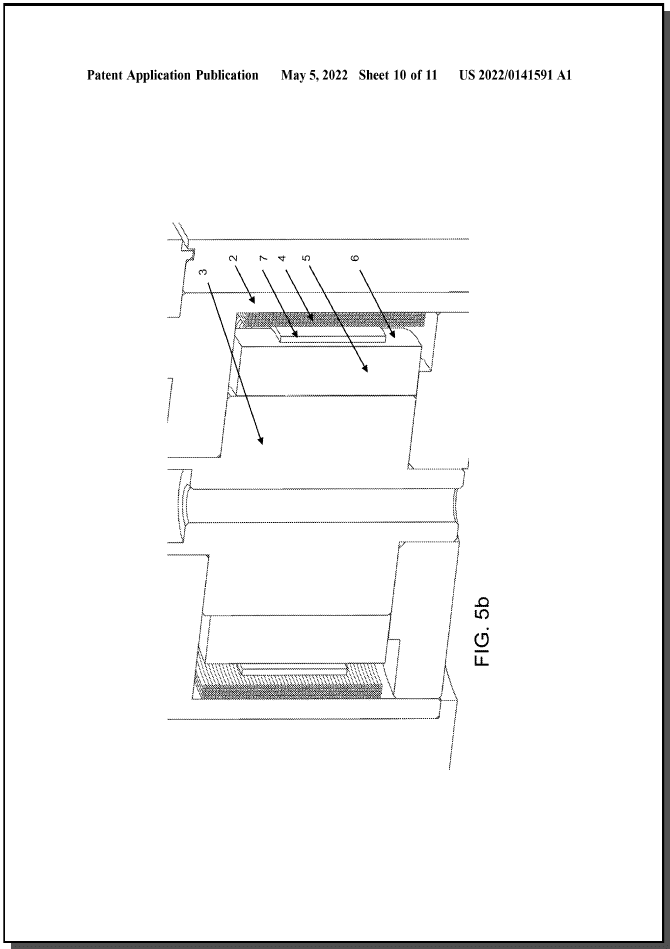
- HEISEL GUILLAUME [CH]; THULIEZ JEAN-LUC [CH]; QUERRY HECTOR [CH]; CROZIER ETIENNE [CH]; HOFFET ADRIEN [CH]; ZIMMERMAN ROBIN [CH]
- 출원인
- OLTRAMARE MICHEL [CH]
- 분류
- Classification: - internationale H04R1/02; H04R9/02; H04R9/06 - coopérative H04R1/028 (US); H04R9/022 (EP, US); H04R9/025 (US); H04R9/046 (EP); H04R9/06 (US);
특허 패밀리 공개번호
프로젝트 이미지
설명
CORRESPONDING APPLICATION
[0001] The present application claims priority over the prior Swiss application No. CH 00136/19 filed on 6 Feb. 2019 in the name of Mr. Michel OLTRAMARE, the content of this prior application being incorporated by reference in its entirety in the present application. TECHNICAL FIELD
[0002] The present invention relates to cooling means for the stationary coil of an induction motor.
[0003] The present invention is for example applicable in the field of actuators generally, and more particularly for loudspeakers and vibrators used in stress endurance tests. These applications are obviously not limiting and other applications are possible within the context of the present invention by invoking the principles described in the present application. PRIOR ART
[0004] Many patents deal with the production of induction motors with stationary coil: U.S. Pat. Nos. 2,621,261A, 4,965,839A, 5,062,140A, 5,742,696A, 6,359,996B1, 6,542,617B1 or even 8,009,857B2. These patents highlight the magnetic, electrical, mechanical or acoustic properties of this type of configuration. Nevertheless, few solutions are proposed for solving the problem of cooling of the coil. On induction motors, that is however a major operating limitation.
[0005] Indeed, the current circulating in the coil causes it to heat up then, by conduction and radiation, causes all the parts of the motor to heat up. The increase in temperature provokes a modification of the impedance, and therefore a disturbance of the current, the latter being determined by the impedance. The consequence of that is a variation of all the characteristics of the motor, notably the magnetic field generated by the coil and the force developed by the moving armature. In the case of a loudspeaker, the increase in temperature of the diaphragm linked to the armature leads to a variation of its modulus of elasticity. That will therefore vibrate differently according to its level of heating. Thus, all the performance characteristics of the induction motor vary simultaneously under the effect of the temperature, making it difficult to control. In the case of a production in the form of a loudspeaker, these elements therefore have a fundamental importance and influence on the quality of vibratory rendering of the motor and the sound from the loudspeaker.
[0006] On the loudspeaker motors that are most commonly used, the coil, commonly called “voicecoil”, is movable and fixed onto the diaphragm. This mobility creates a relative movement between the coil and the air which surrounds it, producing a rudimentary natural cooling. It does however prevent any really effective cooling. Some patents nevertheless propose certain solutions: GB1348535A, JPH03239099A, JPS5586288A, JPS56161798A, JPS59216394A. These solutions however have an impact on the efficiency of the motor, the liquids in contact with the coil slowing down its movement.
[0007] In fact, to mitigate the drawbacks associated with the increase in temperature as described above, the columns of enclosures containing the loudspeakers are often duplicated, one column operating while its twin is stopped. The operator thus switches over from one column to the other when the temperature of the loudspeakers of one of the columns reaches a level of operation for which the sound quality is affected too much. The number of columns of enclosures to be transported and implemented is thus doubled, which increases the sound system hardware investment, and the bill to the organizer of the event.
[0008] Finally, the heating problems are restrictive for the choice of the material of the magnets: beyond a certain temperature, the magnets become demagnetized and unusable. They therefore have a maximum operating temperature which must be observed. Overall, the stronger the magnetization a material has, the lower its operating temperature becomes. Since the current induction motors become very hot, the materials used to produce the magnets are not the most optimal in terms of magnetism. SUMMARY OF THE INVENTION
[0009] The present invention makes it possible to overcome all of the abovementioned drawbacks and notably proposes achieving the cooling of the stationary coil of an induction motor. The application presented hereinbelow is that of an actuator driving a loudspeaker, but the invention can be used for all electromagnetic actuators, such as, for example, vibrators and other applications.
[0010] In one embodiment, the motor, as defined in the preamble to the claims, is characterized in that it has a stationary coil positioned outside of the cylinder formed by the armature, and means for cooling it. These means explained below can be applied separately or together with one another in different illustrative and nonlimiting embodiments.
[0011] In embodiments, the magnets of the motor are formed by a material with high energy density and low operating temperature. For example, these materials are alloys of neodyme, iron and boron Nd<2>Fe<14>B such as N48H, or N50M or other equivalent and appropriate materials.
[0012] According to embodiments, an outer bowl, in which the coil is placed, is provided with a plurality of fins, increasing the contact surfaces with the external environment. The fins can be formed directly on the bowl or added. They can be made of steel, stainless steel, aluminum or any other material that has good thermal conductivity.
[0013] According to embodiments, the motor can be configured to allow an air knife to dispel the hot air around the coil in order to cool it with colder air coming from the outside.
[0014] According to embodiments, the motor can comprise openings between the magnetic air space and the external environment, allowing a flow of air generated by chimney effect to cool the coil.
[0015] According to embodiments, the motor can comprise a fan and one or more openings between the magnetic air space and the external environment, creating a circulation of air around the coil and a reduction in temperature in the magnetic air space, the air coming from the outside and following the geometries of the coil by Coanda effect, increasing the heat exchanges.