

US2022141591 (A1)
System for cooling the stationary winding of an induction motor.
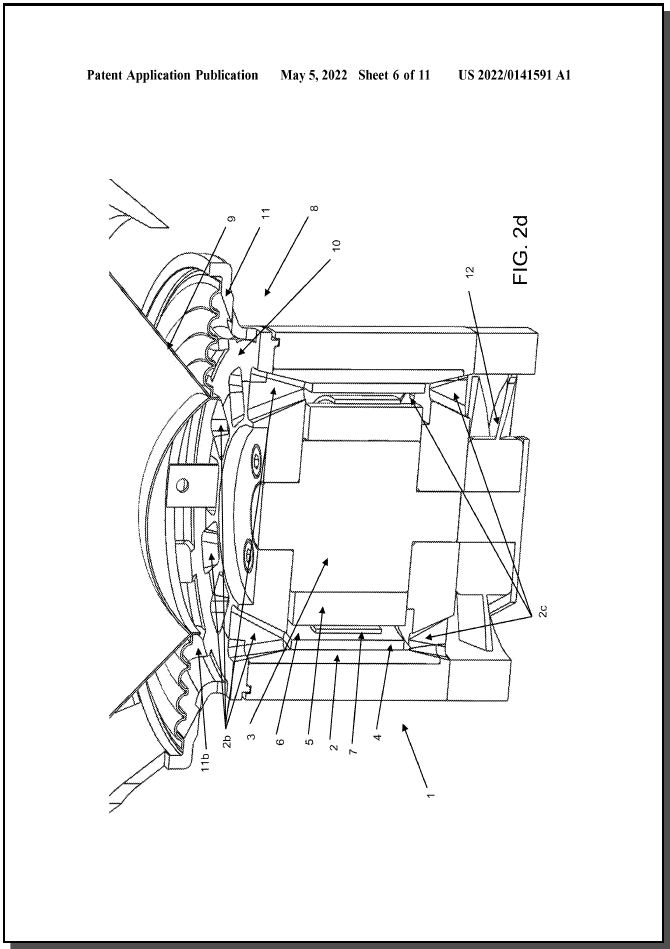
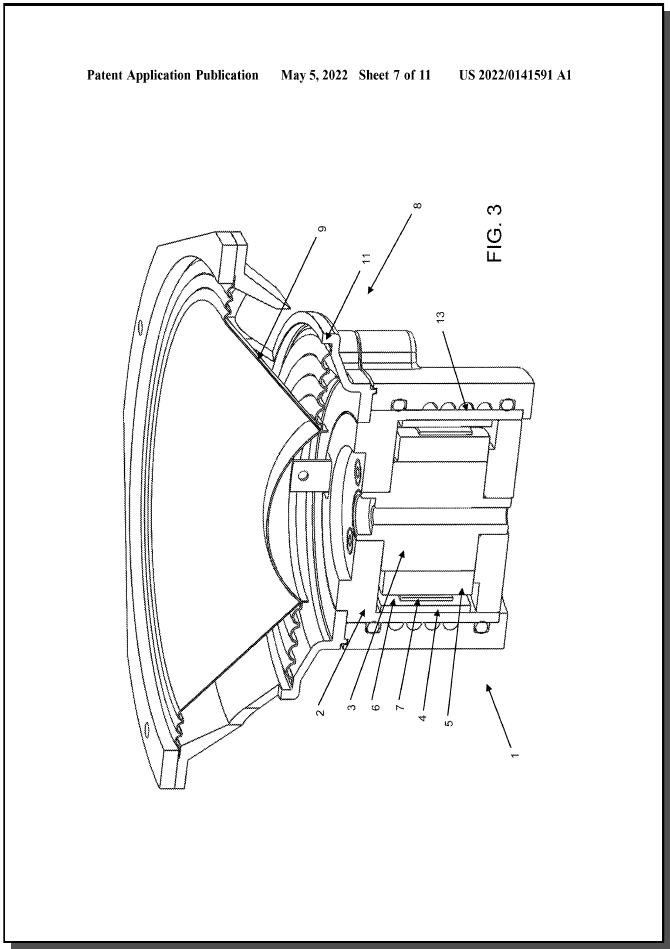
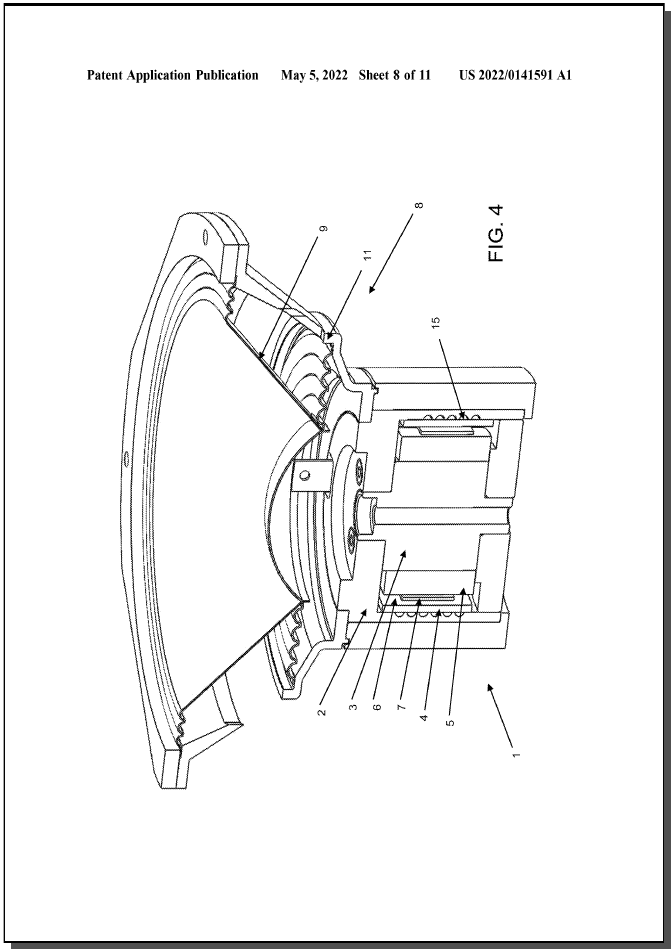
The present invention relates to principles for cooling the stationary winding of an induction motor, said winding being positioned outside the movable armature. The cooling can be achieved by means of cooling fins, openings allowing the ventilation of the winding with or without a fan, a fluid circuit outside the bowl, a fluid circuit inside the bowl, a fluid circuit inside the winding, and/or the addition of heat pipes inside the bowl. This motor as presented can be used, without limitation, inside loudspeakers or vibrators.
- Publication
- US2022141591 (A1)
- Publication date
- 2022-05-05
- Priority date
- 2019-02-06
- Inventors
- HEISEL GUILLAUME [CH]; THULIEZ JEAN-LUC [CH]; QUERRY HECTOR [CH]; CROZIER ETIENNE [CH]; HOFFET ADRIEN [CH]; ZIMMERMAN ROBIN [CH]
- Applicants
- OLTRAMARE MICHEL [CH]
- Classification
- Classification: - internationale H04R1/02; H04R9/02; H04R9/06 - coopérative H04R1/028 (US); H04R9/022 (EP, US); H04R9/025 (US); H04R9/046 (EP); H04R9/06 (US);
Patent family publications
Project images
Description
CORRESPONDING APPLICATION
[0001] The present application claims priority over the prior Swiss application No. CH 00136/19 filed on 6 Feb. 2019 in the name of Mr. Michel OLTRAMARE, the content of this prior application being incorporated by reference in its entirety in the present application. TECHNICAL FIELD
[0002] The present invention relates to cooling means for the stationary coil of an induction motor.
[0003] The present invention is for example applicable in the field of actuators generally, and more particularly for loudspeakers and vibrators used in stress endurance tests. These applications are obviously not limiting and other applications are possible within the context of the present invention by invoking the principles described in the present application. PRIOR ART
[0004] Many patents deal with the production of induction motors with stationary coil: U.S. Pat. Nos. 2,621,261A, 4,965,839A, 5,062,140A, 5,742,696A, 6,359,996B1, 6,542,617B1 or even 8,009,857B2. These patents highlight the magnetic, electrical, mechanical or acoustic properties of this type of configuration. Nevertheless, few solutions are proposed for solving the problem of cooling of the coil. On induction motors, that is however a major operating limitation.
[0005] Indeed, the current circulating in the coil causes it to heat up then, by conduction and radiation, causes all the parts of the motor to heat up. The increase in temperature provokes a modification of the impedance, and therefore a disturbance of the current, the latter being determined by the impedance. The consequence of that is a variation of all the characteristics of the motor, notably the magnetic field generated by the coil and the force developed by the moving armature. In the case of a loudspeaker, the increase in temperature of the diaphragm linked to the armature leads to a variation of its modulus of elasticity. That will therefore vibrate differently according to its level of heating. Thus, all the performance characteristics of the induction motor vary simultaneously under the effect of the temperature, making it difficult to control. In the case of a production in the form of a loudspeaker, these elements therefore have a fundamental importance and influence on the quality of vibratory rendering of the motor and the sound from the loudspeaker.
[0006] On the loudspeaker motors that are most commonly used, the coil, commonly called “voicecoil”, is movable and fixed onto the diaphragm. This mobility creates a relative movement between the coil and the air which surrounds it, producing a rudimentary natural cooling. It does however prevent any really effective cooling. Some patents nevertheless propose certain solutions: GB1348535A, JPH03239099A, JPS5586288A, JPS56161798A, JPS59216394A. These solutions however have an impact on the efficiency of the motor, the liquids in contact with the coil slowing down its movement.