


US2011081464 (A1)
Device and method for making a frothed beverage with a whitener.
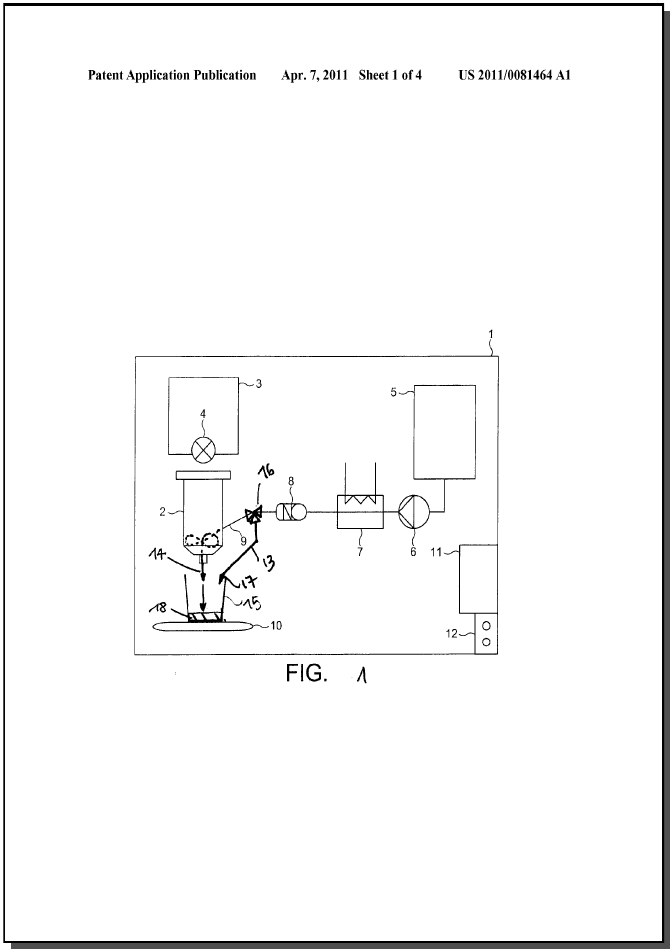
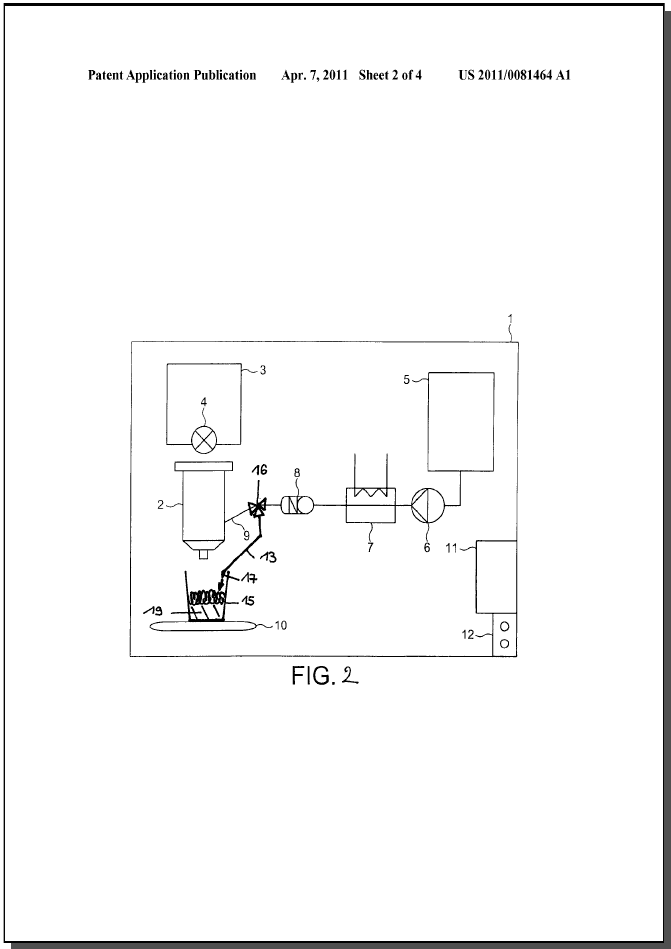
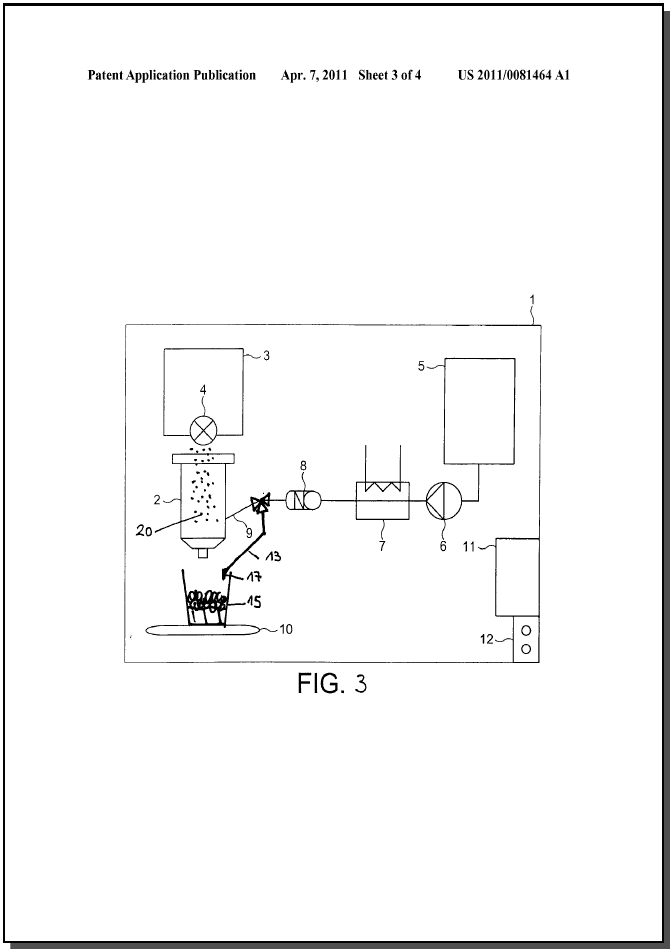
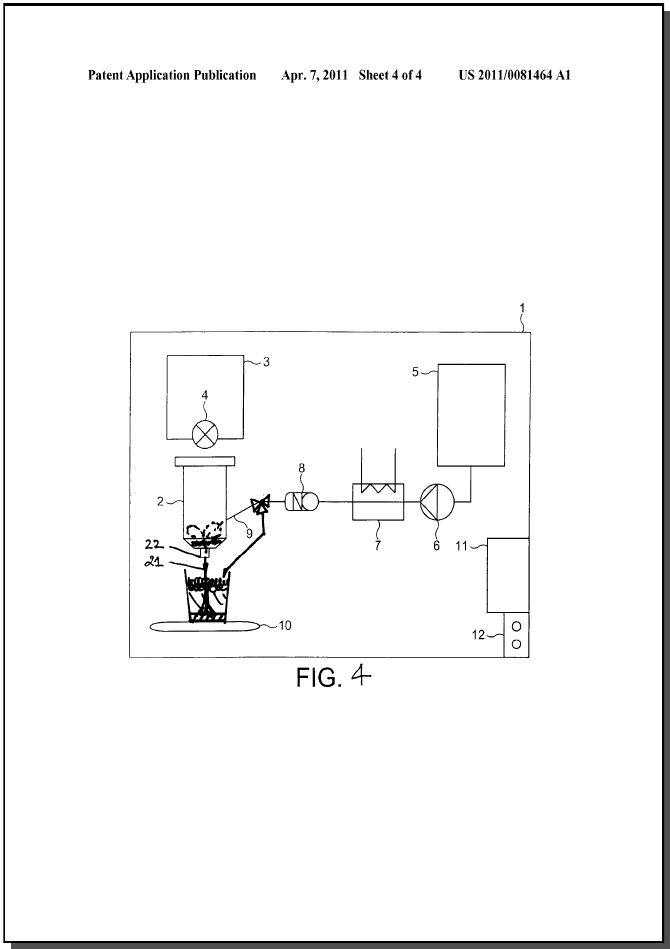
The invention concerns a method for hygienically and automatically producing from a beverage dispensing device a frothed whitened beverage in a receptacle comprising upon the actuation of a command on the device the following operations controlled by a control unit of said device: -a. metering and delivering a pre-warming volume of heated water in a receptacle for prewarming a whitening food component already contained in the receptacle and forming a warmed liquid in said receptacle, -b. metering and delivering a frothing volume of heated water in the form of at least a pressurized jet directed toward the receptacle for frothing the warmed liquid, -c. producing and delivering in the receptacle a liquid mixture made of a second food component and a metered mixing volume of water. The invention also concerns a device for implementing said method.
- Publication
- US2011081464 (A1)
- Publication date
- 2011-04-07
- Priority date
- 2008-05-28
- Inventors
- THULIEZ JEAN-LUC [CH]; GUGERLI RAPHAEL [CH]
- Applicants
- THULIEZ JEAN-LUC [CH]; NESTEC SA [CH]; GUGERLI RAPHAEL [CH]
- Classification
- Classification: - internationale A23P30/40; A47J31/00; A47J31/41 - coopérative A47J31/401 (EP, US)
Patent family publications
Project images
Description
[0001] The invention relates to a method for producing a whitened liquid with a stable top layer of froth in an hygienic and automatic manner. The invention also relates to a device for carrying out such method
[0002] There is a need for providing a simple method through a beverage producing device that enables to deliver in a term of a few seconds a whitened coffee base beverage with a stable foamy top such as a cappucino-type beverage. All the existing methods encounters important drawbacks. Usually, frothing of the whitening liquid, such as a milk-based liquid, requires the use mechanical rotating elements in the device. Such elements must be cleaned after use to avoid bacterial growth and degraded food odor and taste to develop in the system.
[0003] Therefore, it exists systems that remove the need for cleaning of whipping elements. For instance, WO 02/087400 relates to a method for the preparation of a foamed drink from a capsule comprising the operations of injecting liquid in the capsule to mix with the foamable food component and allowing the foamable food component mixed with the liquid to escape from the capsule into the receptacle followed by injecting a high-velocity jet of liquid into the receptacle.
[0004] GB 2 379 624 relates to a beverage making apparatus comprising a liquid injection low diameter nozzle with a tapered bore for reducing risk of blocking the bore with solid scale residue. U.S. Pat. No. 4,388,338 relates to a method for preparing beverages from powder food component in portions by first filling the container partially with water under slight overpressure and by adding cold pressure water to the container while immediately after the container is partially filled with water under slight pressure for effectively mixing the liquid.
[0005] There is a need for a simpler method than existing methods, in particular, that requires minimal intervention of the user for the preparation of a stable, frothed whitened beverage, in particular, a cappuccino-type beverage.
[0006] There is also a need for preparing a hot frothed beverage from a portion of refrigerated liquid food component poured in the receptacle while ensuring a reduction of gradient of temperature in the whole beverage, which is unpleasant for the drinker.
[0007] There is also a need for a device with a simple water feed circuit.
[0008] For that, the invention consists in a method for hygienically and automatically producing a frothed whitened beverage in a receptacle comprising upon the actuation of a command on a beverage dispensing device the following operations controlled by a control unit of said device: a- metering and delivering a pre-warming volume of heated water in a receptacle for prewarming a whitening food component already contained in the receptacle and forming a warmed liquid in said receptacle, b- metering and delivering a frothing volume of heated water in the form of at least a pressurized jet directed in the receptacle for frothing the warmed liquid, c- producing and delivering in the receptacle a liquid mixture made of a second food component and a metered mixing volume of water.
[0012] Preferably, the whitening food component is in a liquid form. It can be fresh milk or a liquid milk concentrate. The whitening food component is typically a liquid taken from a refrigerated storing place, e.g., a fridge, and poured in the receptacle by the user. Therefore, the food component is placed in the receptacle at a temperature below ambient, i.e., 4 to 12 degrees Celsius. According to the method of the invention, the prewarming water volume serves the purpose to rise the temperature of this food component, before frothing, in order to obtain a finally warmed froth layer on the top of the beverage having an elevated temperature.
[0013] In an alternative, the whitening food component can be a powdered food component, e.g., agglomerated milk powder.
[0014] According to a possible mode, the operations a- to c- are delivered successively. Therefore, this multi-step approach ensures that the temperature throughout the foamed part of the beverage is more homogeneous.
[0015] In particular, the prewarming water volume is preferably larger than the frothing water volume. The ratio of the frothing water volume to the prewarming water volumes can be comprised between 1:4 and 1:8. Preferably, the volume of prewarming water is at least 50 mL for a recipe using fresh refrigerated milk as the whitening food component. The volume of prewarming water can be more than 80 mL, for instance about 95 mL, for a recipe using evaporated milk.
[0016] In order to ensure a sufficiently high temperature of the foam, it is important that the prewarming water volume is heated in the device at a stabilized temperature of at least 85° C. The stabilized temperature that is measured is the temperature at the liquid outlet as dispensed from the device.
[0017] A relatively small water frothing volume can be sufficient to energically froth the warmed liquid in the receptacle provided it is in the form of a pressurized jet. For instance, water volumes of less than 20 mL, e.g., 17 mL can be sufficient to froth 130 mL of warmed liquid corresponding to 70 mL of fresh milk and 60 mL of hot water. Also, less than 20 mL, e.g., 17 mL of frothing water is sufficient to froth 130 mL of warmed liquid corresponding to 35 mL of condensed milk and 95 mL of hot water. Of course, larger volumes of the whitening food component will require proportionally larger prewarming water volumes and larger frothing water volumes. This frothing volume is also depending on the pressurized jet's diameter and the pump pressure.
[0018] Therefore, the frothing water volume is preferably delivered in the receptacle through a nozzle of a diameter comprised between 0.2 and 1 mm, preferably between 0.3 and 0.9 mm. In another embodiment, the frothing water can be delivered through several nozzles. In this latter case, preferably, the sum of the sections of the frothing nozzles outlets is the same presents the same value as the section of a unique frothing nozzle presenting a diameter comprised between 0.3 and 1 mm.
[0019] According to the method of the invention, the liquid mixture, made of the said second food component, is usually produced by dosing a dry powder dose of the second food component from a reservoir in a mixing chamber and feeding in said mixing chamber the mixing water volume in the mixing chamber and delivering the mixture through a chamber outlet of the mixing chamber. Preferably, the mixing chamber does not comprise any inside moving parts. In particular, the mixing chamber is carried out only by means of at least one pressurized jet of water entering the mixing chamber. A preferred mixing chamber is described in the co-pending European patent application number EP 06125772.1; the content of which is incorporated herein by reference. The pressurized jet in the mixing chamber is obtained by passing water through a nozzle of a diameter comprised between 0.3 and 0.8 mm. The flow conditions through the nozzle can be such that a linear velocity in the order of from 10 to 50 m/sec., more preferably 12-25 m/sec., is produced.